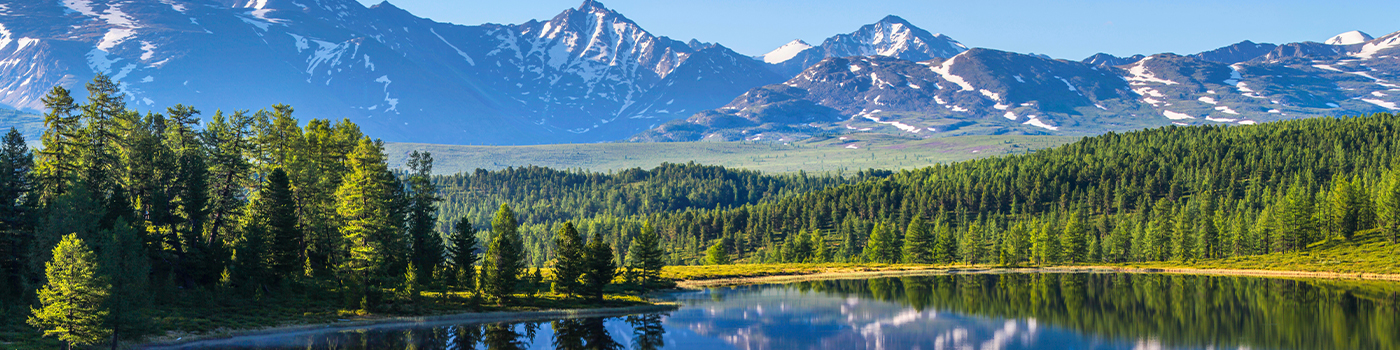
Khakassia: Nature in Full Grace
A Chapter Revealing How Abundant in Natural Wonders the Astonishing Republic of Khakassia Is...
Delving further into the vast Siberia, we now turn to a republic located in its southern part. What comes to mind when you hear "Khakassia"? You probably picture steppes and open plains and you're not wrong, but that's just one piece of the puzzle. The Republic of Khakassia boasts towering peaks and wild taiga, healing waters and scenic valleys, unique flora amid ethereal skies, reigned by tranquil vibes. The scenery here is so stunning that no camera can ever capture the full magic of it all.

Khakassia's Climate
Locals proudly call their homeland "Warm Siberia" – and for good reason: It gets more sunny days than any of the surrounding regions. It results from its location within the Khakass-Minusinsk Basin, which is shielded from winds by surrounding mountains. In general, the region has a sharply continental climate marked by scorching arid summers and winters with scant snow.
Khakassia's nature stands out for its diversity and uniqueness. Its modest expanse hosts almost all landscapes typical of Siberia: Steppes and semi-deserts, pine forests and dark-coniferous taiga, alpine meadows and tundra.
Mountains of Khakassia
Majestic mountains seem to embrace this land, evoking a unique sense of magnificence and mystery. Two-thirds of the republic are covered by them: The eastern slopes of Kuznetsk Alatau in the west, the northern hillsides and chains of Western Sayan in the south. For tourists, these mountain systems offer various opportunities for active recreation such as trekking, skiing, river rafting, rock climbing, as well as off-road quad biking.
The mountains in the steppe part of Khakassia have a geological form known as cuestas – where one slope is gentle, and the other is steep. Such summits and ridgelines abound in Khakassia. Mountain Kunya is a perfect example, standing over 500 meters tall on the left bank of the Krasnoyarsk Reservoir, not far from the village of Ust-Abakan. Its southwestern and southern slopes, unlike the remainder, are gently inclined. Once upon a time, it was used as a natural fortress, a refuge from enemy raids, and also as a site for sun-worshipping rituals. Moreover, Mountain Kunya is recognized as a monument of rock art with two prominent petroglyph sites on its slope. Some of the earliest drawings trace back to the 2nd millennium BC.
Among Khakassia's most mysterious natural wonders is the Sunduki Mountain Range, featuring five separate mountain-remnants reaching up to 200 meters high. The ridge received its name from the northernmost mountain, whose summit resembles a chest (sunduk in Russian). Scientists call Sunduki the oldest observatory on the planet. The area is rich in unique archaeological finds, from ancient burial mounds and intricate rock art to special structures once employed for observing the stars, the sun and the moon. Among these treasures is the „White Horse," one of the world's most ancient petroglyphs.

Khakassia's Water Wealth
By virtue of its location in an intermountain basin, the republic is home to practically all types of water bodies: Mountain and steppe rivers, swamps, fresh and salt lakes, springs, groundwater, canals and reservoirs. The largest river is the Yenisei, which serves as a natural border between the territories of Khakassia and Krasnoyarsk Krai. The second-largest river in the republic is the left tributary of the Yenisei, the Abakan River.
Khakassia boasts over a thousand lakes, varying in size, water flow and salinity. One of the largest and most striking of them is Lake Bele, remarkable for the sandy isthmus that cleaves it in two. On one side, the water carries a gentle saltiness; on the other, it runs almost fresh.
The region's most celebrated lake is Shira, a place that has come to symbolize the region itself. It is renowned for its breathtaking panoramic views, pristine air and the healing properties of its mineral water and mud. Lake Tus, known as the "Siberian Dead Sea", is a place where holidays and healing intertwine. Its mineralization reaches 275 grams per liter. The water density lets you lie back effortlessly, as if on a floating pad – all thanks to its high salt content.
Ivanovsky Lakes are one of Khakassia's main water landmarks and perhaps its most treasured gem. Many refer to this place as Siberian Switzerland. The lakes are located not far from the village of Priiskovy, among the ridges of the Kuznetsk Alatau, at the foot of the Ararat and Bobrovaya mountains. The place is unique because glaciers and snow peaks on the summits and slopes of surrounding mountains remain visible until mid-summer. The lakes themselves form a cascade: Four reservoirs connected by rivers and streams, flowing into one another.
The Caves of Khakassia
A significant natural landmark of the republic is its karst caves. In many of them, ancient human settlements and rock paintings have been discovered. Khakassia is home to the second-longest cave in Russia – Pandora's Box. Its passageways stretch for 18 kilometers and plunge 183 meters into the earth. Packed with numerous cascades, grottoes, wells, halls, and about 400 lakes with crystal-clear water. Kashkulak Cave is among the oldest ones in Russia. Strange occurrences have been reported here, phenomena that scientists now attribute to shifts in the earth's magnetic field.
Did you realize how marvelous and diverse the nature of Khakassia truly is? Next time, let's delve into its wildlife.